Quick Takeaways
- Location is critical for quick lube expansion, requiring careful consideration of regional geography, zoning laws, and community acceptance.
- Valvoline adapts its building designs and operations to regional climate conditions and local architectural guidelines to ensure compliance and community fit.
- Community engagement, including local hiring and vendor partnerships, is key to building trust and facilitating smooth expansion.
- Valvoline emphasizes environmental safety and leak containment to address community concerns about environmental risks associated with oil change services.
- Data-driven analysis of traffic patterns and community feedback help optimize location placement and operational hours for safety and convenience.
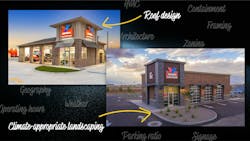
When it comes to real estate, it is often said that the three most important considerations are “location, location, location.” For the automotive service industry, location is crucial to building a solid customer base, ensuring easy access to the shop, and, notably, community acceptance.
All three are critical to any service business. Even as a community will want convenience, there are concerns about increased traffic, noise, parking, market saturation, and cultural considerations. Those are among the many issues Brian Tabb, chief development officer at Valvoline, faces daily as he oversees the brand’s expansion.
With a national footprint of more than 2,300 storefronts, the company operates in or is adjacent to most large municipalities nationwide. But that doesn’t mean that opening a new location is ever “easy,” even for such an established company.
“It is always a challenge,” says Tabb, who is tasked with expanding the number of Valvoline service center locations to more than 3,500 locations in North America.
“Even before we design a new shop, we meet with local city officials,” Tabb tells National Oil and Lube News. “There are always lots of unknowns.”
Addressing those unknowns is something Tabb has extensive experience with. Prior to joining Valvoline in 2022, he was the vice president of real estate and construction at Wingstop Inc. and previously served for more than a decade at McDonald’s, where he was responsible for corporate and franchise growth in the fast-food chain’s East Division.
Different Regions Mean Different Problems
Anyone who has traveled across North America will quickly appreciate that cities share many similarities, but each has its own local charms and challenges. The Midwest is known for cold winters and hot summers; the Southeast generally experiences mild winters but must contend with hurricanes; and the Southwest is prone to drought.
“From a structural standpoint, those are the things we must consider,” explains Tabb. “In a hurricane zone, there are different guidelines, such as steel framing instead of wood. We have to consider the geography as well, so that the shop has ample heating and cooling for the guests and employees.”
Commercial buildings in the Southwest favor flat or low-slope roofs because they are cost-effective, provide space for HVAC and other equipment, and improve wind performance. These can also be fitted with energy-efficient “cool roof” coatings and even solar panels.
“Geography of the shop leads to distinctive features,” adds Tabb. “Architectural guidelines also vary from small towns to big cities.”
In the Zone
Zoning is another consideration for shops, and Tabb tells NOLN that Valvoline remains strategic about where it places its shops. Commercial zoning may require specific rules for building design, size, parking ratios, signage, waste management, safety features, operating hours, and noise.
“From a design standpoint, it doesn’t vary too much,” Tabb acknowledges. “We’re pretty low impact and environmentally safe. Many communities require two levels of containment, but we offer four. We err on the side of caution.
Zoning laws continue to evolve, and different regions have distinct rules that must be considered.
“The hours of operation can vary by region,” says Tabb. “There are also noise issues, which remain a major concern for some communities. We don’t do a lot of repairs that can make noise, but we do try to mitigate any added noise if that is a concern.”
Most of the Valvoline locations have a relatively small footprint of less than an acre, and Tabb says there is generally less traffic than “quick service restaurants” like McDonald’s, Subway, and Starbucks. That can often be a selling point for communities, where residents may be concerned about added traffic, especially in the evening hours.
Having spent time at QSRs, Tabb notes that the quick lube industry typically sees less traffic, a point he is quick to highlight when engaging with community leaders.
“We’re very data-driven,” says Tabb. “We analyze traffic and want to make sure we’re providing convenience to the customers. That includes making sure we have adequate ingress and egress at our locations. We want to keep the traffic patterns safe.”
Another factor is blending into the community, which is a top priority at the company. This includes hiring from within the community and then contributing to its tax base.
“We want to fit in with the way the building looks,” says Tabb. “We make sure to talk to local businesses, use local vendors, including during the construction, and then afterwards, when the shop is running. We also do a lot of community outreach, both nationally and locally, to get loyal customers.”
A Team Effort
As Valvoline expands its footprint, Tabb wears many hats. Still, it is all pulled together by a hardworking team, including those in the Environment, Health, and Safety Department, who can alleviate community concerns.
“There remains a misconception with the oil change industry that there are environmental risks,” says Tabb.
These are points that need to be addressed upfront, that any leaks are rare and have little impact on the neighbors.
“We make sure it is known we go over and above with containment,” adds Tabb. “We also have the resources in-house if there is a problem.”
All of this is necessary because the new location must be a partner to the community.
“We need to get it right the first time, so that the community will allow us to expand and open a second or, in some cases, a third location,” says Tabb. “We want to continue the pace of growth to reach the 3,500 shops, and to do that, we need to be first class in service.”
About the Author

Peter Suciu
Peter Suciu is Michigan-based writer and NOLN freelance contributor who has contributed to more than four dozen magazines, newspapers and websites. He lives in the land of cars not far from one of Henry Ford's estates.