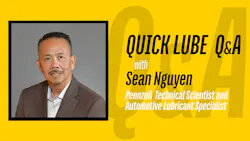
Quick Lube Q&A: Sean Nguyen, Pennzoil Technical Scientist and Automotive Lubricant Specialist
Quick Takeaways
- Switch to high-mileage oil around 75,000 miles or when signs of engine wear, such as leaks or increased oil consumption, appear.
- High-mileage oils contain seal conditioners and detergents designed to maintain engine seals and reduce wear, not to fix major mechanical problems.
- Vehicle usage, maintenance history, and engine condition are crucial factors; mileage alone isn't the sole indicator for switching.
- Quick lube shops should educate customers on the benefits of high-mileage oil as a proactive maintenance step to extend engine life.
- Continuing standard maintenance practices and following manufacturer recommendations remain essential even after switching to high-mileage oil.
As the average age of passenger vehicles in the U.S. continues to climb, a switch to high-mileage oil can help keep drivers on the road and their cars running smoothly.
But at what point should such a change be considered, and what else should drivers know when deciding if making the switch is right for their vehicle?
Recently, National Oil and Lube News caught up with Sean Nguyen, a Pennzoil technical scientist and automotive lubricant specialist. Nguyen has worked with Shell for more than 25 years, holding various positions that include lubricant technical advisor, lubricant product researcher, and lubricant technology trainer.
In this interview, Nguyen identifies the threshold at which drivers generally should consider switching to high-mileage oil in their vehicles, the biggest misconceptions about high-mileage oil, the key points quick lube shops should be prepared to present to guests when discussing high-mileage oil, and more.
NOLN: Why is 75,000 miles considered a key threshold for considering high-mileage oil?
Sean Nguyen: You may see more visible signs of wear in the engine at 75,000 miles. This is also an important time for drivers to help extend the longevity of their engine as they journey forward.
As vehicles log more miles, internal parts such as seals and piston rings can gradually lose flexibility. This can contribute to minor leaks, increased oil consumption, or a slight decline in efficiency over time. These changes don’t happen all at once; however, they can signal that the engine could benefit from more specialized protection.
High-mileage motor oils are formulated with these needs in mind. Products like Pennzoil Platinum High Mileage Full Synthetic use synthetic base oil combined with a tailored additive package, including seal conditioners designed to help maintain seal pliability and reduce oil burn-off, while continuing to protect against wear and sludge. The goal isn’t to change how the engine operates, but to help it continue running smoothly as it ages.
NOLN: Does that number vary by vehicle make/model? In other words, are there certain vehicles for which a switch to high-mileage oil is recommended sooner/later than that 75,000-mile mark?
Sean Nguyen: The short answer: It depends.
Several factors can play a role, including the engine, materials, and overall build quality. Some vehicles will show signs of wear earlier, while others may stay strong well beyond that point. Vehicles that experience frequent short trips, are regularly in stop-and-go conditions, operate in extreme temperatures, or do not keep up with maintenance recommendations may benefit from switching sooner.
That said, mileage alone shouldn’t be the deciding factor. Paying attention to how the engine is performing, including observing a potential increase in oil consumption or small leaks, can provide a clearer signal that it may be time to switch.
NOLN: What are the biggest misconceptions among consumers regarding high-mileage oil?
Sean Nguyen: One of the most common misconceptions is that high-mileage oil is simply a marketing ploy or that it offers no real difference from standard motor oil. In reality, it is formulated with a specialized additive package designed specifically for aging engines. These additives can include seal conditioners and enhanced detergents that help address common wear-related issues.
Another frequent myth is that switching to high-mileage oil can cause leaks. These oils are designed to do the opposite. By helping maintain seal flexibility, they can reduce the likelihood of minor leaks and help manage oil consumption as engines accumulate miles.
It’s also important to clarify that high-mileage oil isn’t intended to fix major mechanical problems. Instead, it plays a supportive role: helping manage normal wear and maintain performance over time as part of a broader maintenance approach.
NOLN: What key points should quick lube shops present to their customers when discussing the use of high-mileage oil in their vehicles?
Sean Nguyen: Quick lube shops should focus on making high-mileage oil relevant to each customer’s vehicle and driving habits. The first step is educating the customer through a simple conversation about how high-mileage oil formulations are designed to address engine aging while helping maintain performance.
It’s also important to review the vehicle’s condition, maintenance history, and how it’s being used. This helps customers feel more confident that the recommendation is tailored to their specific needs.
Framing high-mileage oil as a proactive maintenance choice can be especially effective. This positions the product as a way to help extend engine life, improve reliability, and support long-term performance—rather than as a reaction to a problem.
NOLN: Is there anything else that quick lube shops should know about high-mileage oil that we’ve not yet covered?
Sean Nguyen: One key point is that high-mileage oil is not a solution for major mechanical issues. Its role is to help address typical, age-related wear and concerns as part of a customer’s consistent maintenance routine.
Shops should also reinforce that switching to high-mileage oil doesn’t replace standard maintenance practices. Customers should continue to follow manufacturer recommendations for oil type, viscosity, and service intervals to ensure optimal performance and protection over time.
About the Author
 Tom Valentino
Tom Valentino
Editor
Tom Valentino is the editor of National Oil and Lube News. A graduate of Ohio University, he has more than two decades of experience in newspapers, public relations and trade magazines, covering everything from high school sports to behavioral health care. Tom’s first vehicle was a 1990 Mazda 626, which he used to deliver pizzas in the summer after graduating high school. Today, he drives a 2019 Jeep Compass, which usually has a trunk full of his daughter’s sports gear. In his spare time, Tom is an avid Cleveland sports fan and a volunteer youth sports coach.
Don't miss Tom Valentino's next article. Sign up for NOLN's Quick Lube Report and This Month in NOLN newsletters.