NOLN at 40 | Staying Power: How the Quick Lube Industry has Evolved and Endured Over 40 Years
Quick Takeaways
- Quick lube industry leaders consistently emphasize the importance of treating employees and customers well, a principle that has remained unchanged since 1986.
- The debate over diversifying services continues, with some advocating for additional offerings like tune-ups, while others focus on core maintenance to simplify customer experience.
- Technological advancements, including synthetic motor oils and digital data systems, have significantly improved efficiency, product quality, and customer service in the industry.
- Challenges such as extended oil drain intervals and supply chain disruptions have prompted industry adaptation and strategic shifts.
- Flexibility and willingness to evolve are crucial for the industry’s future, as market demands and technological landscapes continue to change.
What “makes” an oil business?
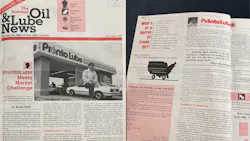
That question was splashed across the top of the front page of the September/October 1986 issue of National Oil and Lube News—just the second edition in the publication’s history—and it’s a query still relevant today.
This month, NOLN kicks off its celebration of covering the quick lube industry for 40 years. During those four decades, operators have come and gone, new technologies and trends have emerged, and brands have evolved with the times to continue serving customers and keeping vehicles on the road.
There are innovations relied upon by shop owners today—sophisticated license plate reader systems that can be the basis for customer databases and personalized marketing campaigns, for example—that were inconceivable in the mid-1980s. But some issues that operators 40 years ago were wrestling with ring true for their successors in 2026.
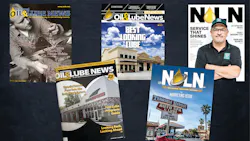
One of the most common sentiments shared with NOLN—from operators in 1986 to those contacted this year—was the importance of treating people well, both employees and customers.
“We need to get the input of the employees. We need to listen to our employees, and we need to see them as the resources that they are,” Tom Whennen of ASAP Oil Exchange in San Diego, California, told NOLN in 1986.
Whether it was training, equipment, or something on the shop floor, Whennen said, “it is our responsibility to respond to their needs and act on it accordingly. It’s basically treating a person as a human being.”
Kyle McMahon, vice president of operations for the West Region for Valvoline Instant Oil Change, echoed those sentiments when contacted by NOLN in March.
“The fundamentals haven’t changed. It still comes down to our core values: Be fast and be friendly,” says McMahon. “The experience a guest has in one store should feel the same as it does in another store across the country
“That starts with taking care of the people who work in our stores. When team members feel supported and valued, they take care of the guests. And when guests have a positive experience, they come back. That cycle of taking care of employees so they can take care of customers has always been at the center of our business.”
To Diversify or Not Diversify: A Timeless Topic
The debate over whether to offer additional services has been waged within quick lube shops for decades. In 1986, Dave Cardwell of Lube-O-Matic in Stone Mountain, Georgia, explained to NOLN that he added a third bay to his shop a year after opening to accommodate more diverse services. Cardwell noted that tune-ups in particular were a profit center for his business because they had a higher markup than oil changes.
“I think the people who do strictly oil changes are going to have a tough time. The market is going to be spread really thin,” Cardwell told NOLN. “If you can offer tune-ups, oil changes, radiator flushes, and automatic transmission service, that’s where it’s going to be.
“You are going to get and keep those customers, and they will be there for the regular oil change just because it’s the place where they get their car taken care of. And that’s why the popularity has come around on your car service centers.”
However, McMahon, who has worked in the fast maintenance industry since the early 1990s, offers a differing viewpoint. In the early 2000s, he says, VIOC began to expand its service offerings based on the belief that it would create more value for guests. In practice, though, it created an experience that was more complicated for both customers and employees.
“Once we stripped away some of the complexity and returned to that mindset, we started seeing real momentum again,” he says. “That reset was a major turning point for how we operate today.”
McMahon recalls periods where the quick lube industry as a whole tinkered with adding services such as windshield repair, brake services, and fuel system cleaners, among others.
“While those services can add value, it gets to a point where if you stack too many recommendations together it becomes overwhelming for customers,” McMahon says. “If someone pulls their car in for an oil change and suddenly hears about 10 different services they could do, it becomes hard for them to know what actually matters for their vehicle.
“What we ultimately learned is that focusing on the most important maintenance items creates a better experience. When customers trust that you’re recommending what truly matters, it simplifies the visit and builds long-term loyalty.”
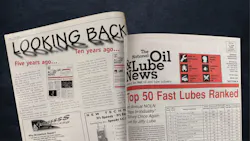
Innovations Advance the Industry
One of the biggest developments in the industry over the past four decades has been the evolution of synthetic motor oil. As of 2025, 73% of quick lube operators say their main bulk oil is standard or premium full synthetic.
Synthetic motor oil predates the quick lube industry. Jiffy Lube opened the first quick lube in 1979, while the first API-certified synthetic oil was AMSOIL’s 10W-40, introduced by Al Amatuzio in 1972.
“There was a whole bunch of other companies that were also trying to figure out a way to get synthetic oil into cars because of the limitations of conventional oil,” says Ed Newman, former advertising manager for AMSOIL and a contributing columnist for NOLN until 2017.
“AMSOIL was successful to a certain extent, then Mobil came out with Mobil 1 a few years later. … The thing that we anticipated was that as cars became more sophisticated, there would be a greater need for high-tech oil. That did happen, but it didn’t happen as fast as everybody thought.”
Adoption of synthetic oil has accelerated over the past decade, though. As of 2015, conventional oil accounted for about 53% of motor oil sales, according to that year’s NOLN Operator Survey. As of 2025, conventional was the main bulk oil used by just 7% of survey respondents.
Emerging technologies, meanwhile, have driven seismic shifts from largely manual processes to a digital-first approach boosted by real-time data available at techs’ fingertips.
“When I started in the early ’90s, a store might have had one computer,” McMahon says. “You'd manually type in a customer’s information, print out a work order, and share that information across the bays. It wasn’t very efficient.
“Today, our systems can scan a VIN and immediately pull up the vehicle’s service history, manufacturer recommendations, and other important information. If a guest visited a store in another state, we can see that history instantly. Technicians also have access to things like vehicle specs, part numbers, and training videos right at the bay.”
Modern Challenges
While some issues from the ’80s are still applicable today, other challenges have become prominent only in recent years. Extended drain intervals driving down the frequency of customer visits has been a challenge noted by several operators in recent years, for example.
Scott Hempy, CEO of Oilstop and a columnist and editorial board member for NOLN, points to supply chain challenges during the COVID-19 pandemic, as well as consolidation and expansion of major national quick lube changes as being among the most noteworthy developments of the 2020s.
He also notes a broad shift in how operators are expanding.
“(Operators are) switching from buying (existing facilities) to building new oil change locations,” he says. “The market was all about acquisition until a few years ago, and now it seems to have switched to be willing to build new locations.”
Keep Adapting
As the subject of NOLN’s first cover story in 1986, Hugo Bustamante Jr., the co-owner of nine ProntoLube stores in El Paso, Texas, offered a prescient outlook on the business. The oil and lube industry could enjoy a bright future, he told NOLN, but it should be willing to evolve as customer demands change.
“If the industry is flexible enough to adapt, it may evolve into something altogether different,” he told NOLN. “That flexibility has to be there, and secondly, you can’t take the long-term liability lightly. You have to be able to understand that things change and you have to be in a position to be flexible enough to change according to what the market is developing.
“Business may change into some other kind of preventive maintenance—what it is, I can’t tell you—so we just have to be flexible enough to design what we are doing to be able to accommodate the greatest number of possibilities.”
***
The NOLN 40th Anniversary is presented by Mighty Auto Parts and Solid Start/True Brand.
About the Author
 Tom Valentino
Tom Valentino
Editor
Tom Valentino is the editor of National Oil and Lube News. A graduate of Ohio University, he has more than two decades of experience in newspapers, public relations and trade magazines, covering everything from high school sports to behavioral health care. Tom’s first vehicle was a 1990 Mazda 626, which he used to deliver pizzas in the summer after graduating high school. Today, he drives a 2019 Jeep Compass, which usually has a trunk full of his daughter’s sports gear. In his spare time, Tom is an avid Cleveland sports fan and a volunteer youth sports coach.
Don't miss Tom Valentino's next article. Sign up for NOLN's Quick Lube Report and This Month in NOLN newsletters.