Built Different: How Quick Lube Operators Stand Out from the Competition
Quick Takeaways
- Lube Tech maintains an 83% customer return rate by focusing exclusively on oil changes and quick services, avoiding ancillary offerings like brakes and tires.
- The shop operates 59 hours weekly, prioritizing quality and consistency over extended hours or Sunday operations, differentiating itself from larger chains.
- Key to success includes serving local market needs, paying fair wages to staff, and continuously updating technician knowledge on vehicle trends and service techniques.
- Lube Tech’s strategic focus on high-volume, fast turnaround services allows it to generate over $1.6 million annually, demonstrating the profitability of specialization.
- Offering unique services like differential and coolant flushes helps Lube Tech stand out, while maintaining a simple, efficient service menu supports operational excellence.
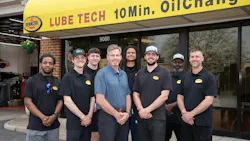
The quick lube industry is nothing if not competitive.
From pricing on oil changes to additional service offerings to hours of operation, shop owners will look for a competitive edge to keep their guests coming back (and draw in new customers as well).
Tommy Moyer, owner of Lube Tech in Mechanicsville, Virginia, has seen plenty of competition—much of it from powerhouse national brands expanding into the area—during his 40-plus years in the business. Still, Moyer’s Lube Tech has managed to maintain a customer retention rate above 80%.
How? By following the lead of his predecessor and steadfastly sticking to his core business.
“I don't do brakes. I don't do tires. I don't get into all the ancillary stuff,” Moyer says. “We do oil changes.”
Moyer continues: “I don't know how that's going for them,” he says of competitors offering tire and brake service, “but we have stuck to our base and keeping it simple.”
Establishing a Game Plan
As a student at Virginia Commonwealth University, Moyer pumped gas at John Molter’s full-service gas station during the evenings. Shortly after graduating from VCU in December 1986, Moyer was approached by Molter with a career opportunity. In addition to his gas station business, Molter had also opened a quick lube shop in Richmond, Virginia, and he was in need of a new manager.
Moyer had planned to go work for one of the region’s Fortune 500 companies after graduation, but Molter convinced him to manage the quick lube for a year. One year, however, became 15, and along the way, Moyer went from a shop manager working for Molter to a partner who collaborated with him on opening a second fast oil change shop in 1996, then a third in 1999.
By 2000, Molter was ready to exit the industry. The first two shops were sold to Jiffy Lube, and Moyer bought out Molter’s share of the third facility, which is the Lube Tech he still owns today.
Lube Tech is located in Mechanicsville, Viriginia, a northeast suburb of Richmond with a population of about 38,600. With three bays over pits and an additional bay with a lift over a slab for tire rotations and other services that require vehicles to be elevated, the shop services about 51 vehicles per day, Moyer says.
In addition to oil changes, Lube Tech does offer a handful of quick add-ons, including differential service, four-wheel drive service, and transmission and coolant flushes. But as national chains with locations nearby have begun to offer brakes and tires, Moyer says Lube Tech is making its mark by sticking to what it does best, emphasizing the “fast” in “fast maintenance,” relying on those service offerings with quicker turnarounds.
“We don’t pay commissions. We don’t pay bumps, and we don’t put any quotas,” he says. “You service the customer’s car, and if they need something, you sell it. If they don’t, then you don’t.”
The formula has been successful for retaining customers, even as competition comes to town. Moyer says his shop has maintained an 83% customer return rate.
“And the only reason it’s not higher is if they bring a new vehicle in, that’s considered a new car,” Moyer notes.
Lube Tech is open 59 hours a week—8 a.m. to 6 p.m. Monday through Friday, and 8 a.m. to 5 p.m. on Saturdays. The shop stays closed on Sundays, although Moyer says he sometimes comes in on Sundays to take care of paperwork. Nearby Jiffy Lube and Valvoline locations stay open later and also take customers on Sundays, but Moyer stays the course.
“Yeah, I mean, you feel the urge (to go to seven days a week),” Moyer acknowledges, “but (we are going to) continue doing what we’re doing, and we do it right and have been successful.”
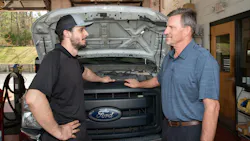
Keys to Success
Moyer tells NOLN he does not view other independent shops as competition in the same way he does franchise chains. Asked what advice he has for shop owners with similar profiles who are looking to make their businesses stand out from the competition, Moyer is modest.
“I’m not saying that what I’ve done you can print out on a sheet, and it’s a gold model,” he says.
That said, he does have a few tips:
Serve the needs of your market. Keeping it simple works for Lube Tech because the shop sits in a high-traffic location in a bustling region. The Richmond, Virginia, metro area has a population of about 1.4 million with a median household income of $83,460, per 2024 U.S. Census data.
“But in some of these small towns, you see a little two-bay shop, and I would think just doing oil changes, you can’t survive. You would have to do tires, brakes, tune-ups, you know, whatever, because you can’t really survive if you have a $100 ticket average, especially nowadays with most cars being synthetic.”
Moyer does some quick math to make his point: “With 50 cars a day times about a $110 ticket average, that’s $5,500 a day. With 308 working days a year, that’s $1.6 million, which is what we did last year.
“If you’re in a smaller market and you can’t grab $100 a ticket, and you’re only grabbing $70 per ticket, let’s say you’re doing 25 cars a day. Well, that’s about $1,750. That ain’t a lot of room for anything.”
Treat your employees right and pay them a fair wage. Customers like seeing familiar faces when they come into the shop, so to minimize staff turnover, Moyer says Lube Tech’s compensation structure has increased significantly from his first days in the business, when techs received the minimum wage of $4.75 an hour and managers were paid $7 an hour.
Among its full-time employees, Lube Tech has three staff members who have worked in the shop for more than 20 years. The “newcomer” of the team has been with Lube Tech for three years.
“My customers love seeing the same people here,” Moyer says.
Stay current on vehicle trends. Moyer says institutional knowledge can be a big differentiator for quick lubes. Having experienced, well-read technicians on staff has allowed Lube Tech to service vehicles that some other fast oil change shops will not.
“It’s crazy how this (business) has evolved,” Moyer says. “My guys are very knowledgeable. Of course, we have the ISI system, the electronic manual, and everything. But (while other shops) have stayed away from doing BMWs and Mercedes because you’ve got to put the right oil in and the filters are different, we don’t shy away from anything and we do everything.
“We read up on it, and we get it done.”
Unique Offerings
For some quick lube and fast maintenance shops, standing out from the competition comes down to offering services that no other shops in their area match. For the 2025 NOLN Operator Survey, we asked owners, operators, and shop managers about their additional profit centers and the services they deliver beyond basic oil changes.
Additional Profit Centers
68.4% Full service auto repairs
50.5% Tire sales and service
28.4% Car wash
14.7% EV services
Additional Service Offerings
Most Common
94.2% Replace engine air filters
94.2% Replace cabin air filters
91.3% Sell conventional wiper blades
91.3% Sell beam wiper blades
89.9% Change differential fluid
89.9% Replace lights
Least Common
11.6% Repair rock chips in windshields
24.6% Offer a coolant to stop leak additive
26.1% Offer smog checks/emissions tests/state certifications
26.1% Offer a transmission stop leak additive
33.3% Offer an oil leak stop additive
37.1% Offer a power steering treatment additive
Source: 2025 NOLN Operator Survey Report
About the Author
 Tom Valentino
Tom Valentino
Editor
Tom Valentino is the editor of National Oil and Lube News. A graduate of Ohio University, he has more than two decades of experience in newspapers, public relations and trade magazines, covering everything from high school sports to behavioral health care. Tom’s first vehicle was a 1990 Mazda 626, which he used to deliver pizzas in the summer after graduating high school. Today, he drives a 2019 Jeep Compass, which usually has a trunk full of his daughter’s sports gear. In his spare time, Tom is an avid Cleveland sports fan and a volunteer youth sports coach.
Don't miss Tom Valentino's next article. Sign up for NOLN's Quick Lube Report and This Month in NOLN newsletters.