A Deep Dive Into AI: The Digital Tools Entering Quick Lube
Quick Takeaways
- AI tools like PitCrew utilize existing shop cameras to monitor vehicle entry, service times, and technician activity, boosting efficiency by at least 10%.
- Revmo AI handles customer calls, texts, and emails, allowing technicians to focus on service while maintaining high customer engagement during and after hours.
- These AI solutions help detect discrepancies, improve security, and provide valuable data insights, enabling shops to optimize operations and enhance customer satisfaction.
- Implementation is flexible, with most AI tools designed to integrate with existing hardware and prioritize data privacy and security.
- Industry leaders report significant improvements in speed, efficiency, and customer experience, demonstrating AI's growing role in auto service innovation.
At times today, it can seem that artificial intelligence is inescapable. If you’re in the quick lube industry, you’ve likely wondered what, if anything, this technology means for you. But in a field defined by speed and efficiency, companies behind AI tools have seen auto service as an opportunity to further streamline everyday tasks for shops.
That concept has laid ground for several new products cropping up in the quick lube space. Chains like Jiffy Lube and SpeeDee Oil Change have already seen entire franchisee networks implement AI tools in their own stores.
To get a better look at how shops are using these tools, we spoke with the companies behind a couple of leading AI products marketed to quick lubes to understand what these tools do and what exactly is being offered to auto service businesses.
PitCrew by Leverege
Leverege started in 2014 with two engineers as co-founders, plus a CEO who is a multi-time entrepreneur with over 30 years of experience. The business initially began in the IoT—Internet of Things—and B2B/enterprise space, building asset tracking and other IoT-based solutions using devices and sensors.
Over time, the company realized that cameras are extremely versatile sensors, so about five or six years ago, they began focusing on computer vision and AI and machine learning. That shift led to the expansion into multiple industries, including automotive service, and the creation of PitCrew, their automotive service center product.
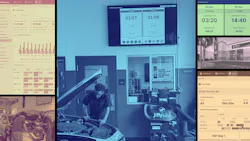
So, how exactly is a platform like PitCrew utilizing AI? For Leverege’s tool, AI models watch a shop’s bay cameras 24/7 to detect when a car enters and leaves a bay, as well as start and stop a service timer, without any staff input.
As part of PitCrew onboarding, shops typically install a large screen in view of the team. The service timer being started and stopped by AI will then feed TV dashboards in the bays, so techs and managers see how long each car has been in service and when they’re nearing or exceeding targets, such as a 15‑minute oil change.
Using cameras installed in the shop, AI models can pick up a lot of other data as well. It can detect the make, model, and color of vehicles, and even tracks how many technicians are working on each car over time.
“That can help with identifying if the vehicle's just been sitting there with nobody working on it,” says Calum McClelland, chief operating officer for Leverege.
That same technology is used to measure customer foot traffic as well. The AI counts people entering and leaving the store to give foot-traffic metrics. Additionally, outside, it monitors the queue of cars, how long they’re waiting, and when people drive off without service.
Security features are embedded in PitCrew as well, with the ability to detect people on the property after hours. McClelland also notes that AI-detected car counts can be compared with point-of-sale invoices to help detect discrepancies that may indicate theft.
“You can say, ‘Well, PitCrew saw 100 cars, but there's only 80 invoices. What's going on there?’ And sometimes it's not nefarious and there's a good explanation, but sometimes there's not, unfortunately. And it can enable catching those things sooner,” says McClelland.
PitCrew doesn’t require any special custom cameras; its AI models can integrate fine with any functioning shop camera network.
“This all utilizes existing cameras and infrastructure inside of service centers. Most companies have security cameras that are brand new to many years old, and we basically layer on this capability with our software to turn those dumb cameras into smart cameras without having to buy any additional hardware,” adds Chief Revenue Officer Ryan Chacon.
It requires a lot of data to be collected, but each platform will have its own guidelines and standards for how that’s handled. With PitCrew, shops are the owner of all video data captured on-site. The AI runs locally on an edge appliance in the shop, with video stored locally, although some video can be stored in the cloud if a shop chooses.
Additionally, PitCrew has the ability to blur entire faces and bodies in footage. Blurred video is what goes to the cloud, and it cannot be unblurred. McClelland stresses that full raw video is not routinely sent to the cloud, rather an edge box processes feeds and sends metrics and events, like service times, to their cloud platform.
“These AI models are running in the stores at the edge, so that way we can do all this processing locally, and not be sending up full video of customers, employees, etc. to the cloud, so we can really preserve the privacy there, because that's really important to us,” says McClelland.
Leverege says its clients have seen a demonstrable gain from using their product: McClelland cites a minimum of 10% improvement in overall efficiency and speed as being typical for most of their customers. And where one of the biggest benefits comes from is the automation of visible timers.
“The primary way that PitCrew helps do that (improve speed) is by having a real-time sense of how long this is taking,” McClelland explains.
That is what tools like PitCrew are best used for: not replacing tasks that would be done by a human, but rather helping automate repetitive functions in a shop that otherwise fall through the cracks.
It looks different in front of house, but the same concept applies. The PitCrew dashboard has a function that automatically highlights services exceeding the shop’s target time, marking it as a priority for store managers to do what they do best: analyzing and resolving situations within the store’s day-to-day operations.
Richard Jennings, executive director for Jiffy Lube franchisee Atlantic Coast Enterprises, shared that ACE will be launching PitCrew across all 66 of its stores over the next few months, after a successful pilot phase. Jennings reported improved speed of service in their stores after implementing PitCrew.
Additionally, directors and executives at ACE have also found use for AI when it comes to analysis of areas like marketing.
“We are just scratching the surface when it comes to the use of AI within our particular business and our industry, but it has most definitely already had a positive effect in our company—improved time management and efficiency; KPI trend analysis; and improved upon our guest experience both on phone and in store,” Jennings shares with NOLN.
Revmo AI
Some AI platforms are honing more on what they can offer in the realm of customer service. Revmo AI, a Phoenix-based company specializing in voice-enabled conversational AI technology, specializes in handling phone calls for auto shops. The platform is notably being used by Stonebriar Auto Services, LLC: one of Jiffy Lube’s largest franchisee, overseeing 128 locations across the U.S.
Revmo doesn’t just receive calls, but also answers inbound phone calls, emails, and texts for a shop. It’s designed to be used not just during afterhours, but during store hours; ideally to keep techs from being pulled off the shop floor, in absence of a manager or service advisor to answer the phone.
“Revmo has had a direct impact on our operations. Our technicians can focus on service, while Revmo ensures no customer is left unattended,” is how Steve Isom, executive VP of Stonebriar Auto Services, described their use of the platform.
For Stonebriar, the company is increasingly relying on services like Revmo’s. As shared by Revmo with NOLN, Stonebriar says it’s handled over 132,758 inbound calls with Revmo, with an attributed revenue per location of $6,000/month.
As with all AI platforms, Revmo has its own data usage policy as well. The company says it collects basic user and usage data, including account info, device data, and interaction data, to operate and improve its AI communication platform, but does not train large language models (LLMs).
The data is used to power features like automated calls, texts, and analytics. Revmo notes it may share data with service providers but does not directly sell personal data. The platform uses standard security practices, and complies with regulations like CCPA and TCPA.
Figuring Out What’s Right for You
Each shop’s needs will look different—it will be crucial to examine what you’re seeking to get out of using an AI platform and what will maximize quality for your own staff and clients.
Auto service isn’t the only field seeing an influx of new technologies powered by AI, and like every other sector, business owners will have a plethora of options to research before making the best choice. From automating timers, to handling the phones, there’s a wide array of how the technology can be deployed. The auto service will have much to learn about how to best harness those tools, especially as they evolve.
About the Author
 Kacey Frederick
Kacey Frederick
Assistant Editor
Kacey Frederick joined as the assistant editor of NOLN in 2023 after graduating from the University of Arkansas at Fort Smith with a bachelor’s in English and a minor in philosophy. The grandchild of a former motorcycle repair shop owner, he’s undergone many trials and tribulations with vehicles. Now the proud owner of a reliable 2011 Toyota Camry, he works to represent those in the service industry that keep him and so many others safely rolling on.