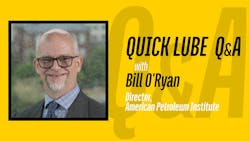
Quick Lube Q&A: Bill O’Ryan, American Petroleum Institute
The American Petroleum Institute announced recently that progress continues toward the development of the next car engine oil category: ILSAC GF-8.
The new category will help to boost fuel economy and improve protection of HEV engine operation and higher temperature internal combustion engine operation. Launch of the new category is slated for the third quarter of 2028, but there are many hurdles to clear to reach the finish line.
Recently, NOLN caught up with American Petroleum Institute Director Bill O’Ryan to get a status update on the development of GF-8 and learn more about next steps in the process.
Editor’s note: This interview has been edited for length and clarity.
NOLN: For those who are not familiar, can you provide us with the basics on the process for developing a new category of car engine oils?
Bill O’Ryan: The process generally starts with the OEMs that form ILSAC. That would be the North American OEMs and the JAMA (Japan Automobile Manufacturers Association) members in in Japan. They come forward with a request, and that request is then vetted through our committee that's called the AOAP (Auto Oil Advisory Panel). And that panel is made up of the OEMs, the oil marketers, the additive companies, and of course we also include the test labs. Other members of trade organizations … are welcome to attend that.
That process is kicked off by the request, and then some formal questions are raised that are cataloged in API 1509, which is our internal standard that can be found online in Annex C, which is where the entire process is well documented as to what has to happen in order for a new category to be approved.
Once that panel meets and has discussions and the questions are answered… Some of those questions are, you know, why do you need a new category? Can't this be solved by an existing category? Are there any regulatory requirements coming that might be driving this, and if so, what are they and what does that mean for you as an OEM? We’ve gone through that the initial process, and it was deemed necessary that we start developing GF-8. So, that's where we are now in that process. That kicks off all of the real work, which is test developments and limit setting down the road and all of that.
NOLN: Can you tell us a bit more about where you’re at in the development cycle for GF-8?
Bill O’Ryan: Right now, we are into the point where we're in development mode of ILSAC GF-8. The AOAP met and had many discussions over the course of a couple of months. We asked a lot of questions, as an industry, of the OEMs.
And the OEMs came back with answers that yes, it's necessary. Some of the major needs from the OEMs are more fuel economy, enhanced viscosity, oxidation control. There are a couple of new tests that were introduced into ILSAC GF-7 and API service category SQ that were inserted as rate and report only. Those are the new elastomers—seals that many of the automakers are using in modern engines—and the engine oil gelation test, which was protection against water entrainment and potential freezing in the engine. We need to develop limits for those.
Right now, there are companies running programs through GF-7. They're starting to gather data, and that data will be analyzed as part of the GF-8 process so that we can use that data to make some rational and intelligent decisions around what should these limits look like. Now, beyond just the scope of that, we also have engine tests that are aging out. The sequence IIIH is the oxidation control test. That engine test has been used quite a lot during the GF-7 upgrade, and so tests are running short, so they're looking at ways of trying to remanufacture some of the parts and extend the life of that. There is a new Sequence V] sludge test—currently it's the VH.
They’re looking to move that to a new platform, which would be a four-cylinder engine. That is currently going through what's called prove-out testing at the independent test labs. And then there's the matter of the sequence VIE and VIF fuel economy tests, which are, as I mentioned earlier, aging out. There’s a task group looking at trying to extend the life of those engines as well. So that's all part of category development process, making sure that we have engine tests that are viable for the life of the category.
NOLN: Have regulatory requirement changes proposed by the current administration impacted the development of GF-8?
Bill O’Ryan: That’s a great question. Let me get my crystal ball out. Right now, the short answer is it has not yet, and I'd say one of the primary reasons for that is even if you were to take away the additional fuel economy requests from the ILSAC needs statement, you still have engine tests that are aging out. You still have new tests that have no limits. You still are looking for improved oxidation control, which is something that you need regardless of EPA requirements. So, the short answer is not yet, and it possibly will have no impact.
We’ve seen that even more recently on the heavy duty diesel side with Proposed Category 12 or PC12. People were asking, what about now? And well, we're so far down the development of the category process. The OEMs have already spent all that money on their own research and development of meeting those requirements. It's going forward. So, there's still time that it could change a bit, but I do not see it really putting a stop to GF-8. The GF-8 timing could slide, but that's a natural occurrence during category development, depending upon the speed with which we can meet timing on engine test developments and getting through the precision matrices and Base Oil Interchange and Viscosity Grade-Read across matrix testing.
NOLN: Based on where development is now, what does your timeline look like and what are your next steps going forward?
Bill O’Ryan: The timeline has not officially slipped yet. It’s still the third quarter of 2028 for first licensing. But again, when you start working backwards—and this is what we like to do, as a project manager mindset—Q3 of 2028, typically we have a one year mandatory waiting period for API so that oil marketers and additive companies have a level playing field to get testing done. That would take you to Q3 of 2027. We typically have a one-year technology demonstration period, which is where the additive companies work to the limits that are being proposed with these tests to see if they can actually produce passing results. That would take you to Q3 of 2026. What do we need to do to get to that milestone?
We need to have all of the engine tests developed and precision matrices run successfully and all of the data analyzed. So, we're already in first quarter of 2026. We're getting close to having some slippage. So, it may not make Q3 of 2028, but it's still theoretically possible.
NOLN: Is there anything else that you wanted to mention before we go?
Bill O’Ryan: These category development processes can take easily two to three to four years. GF-7 was a much accelerated program that went through very quickly. But when you have many engine tests that need developing like during the GF-6 days, that takes a lot of time because the engine labs are working very diligently with the OEMs and the rest of the industry partners to come up with a test that is repeatable, reproducible, and precise. That takes time. That’s where we are right now in the process. I think there's a good chance we could still make Q3 of 2028, but we won't know for the next couple of months.
About the Author
 Tom Valentino
Tom Valentino
Editor
Tom Valentino is the editor of National Oil and Lube News. A graduate of Ohio University, he has more than two decades of experience in newspapers, public relations and trade magazines, covering everything from high school sports to behavioral health care. Tom’s first vehicle was a 1990 Mazda 626, which he used to deliver pizzas in the summer after graduating high school. Today, he drives a 2019 Jeep Compass, which usually has a trunk full of his daughter’s sports gear. In his spare time, Tom is an avid Cleveland sports fan and a volunteer youth sports coach.
Don't miss Tom Valentino's next article. Sign up for NOLN's Quick Lube Report and This Month in NOLN newsletters.