Website Anchors Your Shop's Online Presence
Quick Takeaways
- A website is now a fundamental part of doing business, offering control over branding and customer information.
- DIY services and AI tools have lowered barriers, making website creation accessible for small shops.
- Integrating a website with local directories enhances online visibility and customer engagement.
- Features like appointment booking and customer reviews can be added to improve user experience.
- Tracking website visitors can be implemented later to better understand customer behavior and improve marketing efforts.

A website is essential for any business. It's no longer a "nice-to-have," but a default part of doing business. Independent operators have several resources at their disposal to build a site. It can be done in-house if you have a staff member with web development skills. Do-it-yourself services and AI tools are lowering the barrier of entry for website building as well.
"The irony is, it's never been easier or more cost-effective to build a website," says Scott Steinberg, a business and technology trends expert. "You can build a site just like talking to a human."
Many shops hire an agency, while others go to a familiar resource, such as a vendor with whom they have an existing relationship. One shop in Lancaster, Kentucky, worked with its point-of-sale provider to build a site that offers information for prospective and existing customers.
The Challenge
Quick lube operations are traditionally a drive-up business. Customers might plan for service, or stop in as they drive by and are reminded they need an oil change and/or other related services. That doesn't mean a customer doesn't ever look up information about a shop, its hours, its services, and confirm a location.
Some independent operators feel a listing on Google, Yelp, Facebook, or other local directories is enough. A website offers visibility and branding that others can't replace. It is still important to maintain a presence on local directories, even with a website.
For Jerry Coffman, owner of Garrard Quick Lube in Lancaster, Kentucky, it was a problem he didn't know he needed to solve when his POS provider pitched him on building a website. It immediately made sense to have a website to support the business.
"I just thought we should do it," Coffman tells NOLN. "The company I do my POS sales with set the site up for me. They contacted me and set it up."
The Solutions
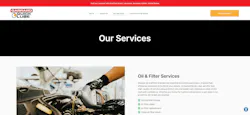
Garrard Quick Lube's website has all the basics: locations, services, about us, contact us, and a map. Some shops have added sections such as the ability to book an appointment, shop photos, or a blog. Those are a "nice-to-have" for the shop, but often need to be maintained with photo and blog updates.
The shop's POS provider pitched Coffman on adding a website as an added service. The existing relationship was a trusted source. The agency suggested a website format, and Coffman was able to adjust a few options to a look he was happy with. The site features selected customer reviews and links to Facebook and Google, where customers can read more about what other customers have to say and interact with the shop.
"My wife handles some of the Facebook content," says Coffman.
The Aftermath
The shop with two bays and three employees, located south of Lexington, can easily be found on its website and on Google. "I guess I just know that people can find me that way," Coffman explains.
What the site doesn't offer at this time is a way to track customers who come in from the website. Coffman does track customers who come in through text-messaging programs and other campaigns.
Garrard Quick Lube has had its website up for about a year. It is a benefit to the shop, but difficult to quantify.
"I was going to cancel it, then they dropped the price," Coffman says. "That's the reason I got it."
If it becomes important to the shop to track site visitors and connect them to customers, there are options its website developer can implement, or the shop can set up on its own.
"When you build a site, there is an endless array of online services and add-ons that make it easy to see where users are coming in from, who they are, and other vital information," states Steinberg.
The Takeaway
Direct results from the investment may take time, but it is good branding and useful to have at least a basic website. Customers can look up the shop, find its location, check hours of operation, and confirm the services offered, among other actions. A shop has more control over what appears on its own website than its Google listing, or even a page on social media. The website ties into the shop's offering by providing information.
"Your online presence is as important as your in-person presence and trusted presence on social media," Steinberg tells NOLN. "It may not seem like it's having a big effect on sales, but it is."
Steinberg notes that websites, especially mobile-friendly sites, will be important in the future, as "the vast majority of generation Z and beyond use AI and social media to search for services."
The website feeds the data on AI and social media. "It's a huge engine of discovery for your business," Steinberg states.
About the Author
 Enid Burns
Enid Burns
Enid Burns is a writer and editor living in Grosse Pointe, Michigan, and is a freelance contributor to NOLN. She has covered a wide range of topics from video games and consumer electronics to online advertising and business. While living in Manhattan for 20 years, she did not own a car and is now often mistaken for the woman who brings her car to the shop and knows nothing. She has learned a great deal from writing for NOLN, and she also learns from shop owners who try to educate her about their services. Enid is a news junkie who spends evenings streaming TV shows and time off on long walks, bike rides, and fiber arts.